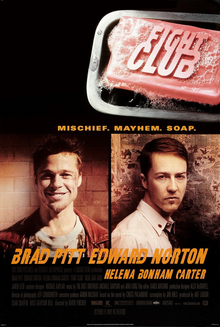
 As I read our longest reading assignment of the year - Rousseau’s Discourse on the Origin of inequality, I couldn’t help but notice some similarities it had to the ideas presented in the 1999 movie Fight Club starring Brad Pitt and Edward Norton. This was pretty cool for me, considering that Fight Club is one of my favorite movies (If you haven’t seen the movie, there's spoilers in this blog). I will attempt to proceed through all the “teachings” of Tyler Durden in the movie and explain how each pertain to Rousseau’s ideas. Also, just like how Professor L.-Manty put it, some of these ideas are very radical - so understand that I’m merely presenting them, not endorsing them.
The nameless main character of the movie (played by Edward Norton) - let’s just call him Jack for clarity’s sake - first meets Tyler Durden (played by Brad Pitt) on an airplane. When Jack asks Tyler what he does for a living Tyler responds with “Why, so you can pretend like you’re interested?” With one of the first lines uttered by Tyler in the movie, he has already highlighted a very important question - Why do we all put up a socially-dictated facade in an attempt to make ourselves more pleasant to others? Every day, we act friendly, we hide our true opinions in front of others - we play nice. And then next thing you know, we’re talking bad about our friends behind their backs. Why do we do that? Why not just say what we really think to their faces and not be fake? The answer is that we care about what others think of us - we don’t want everyone to hate us! In a society described by Rousseau, the modern man “...only knows how to live in the opinion of others...”. Therefore we are all governed by fear of not being accepted by others, which to Rousseau - and Tyler Durden - is just crazy.
 |
| “WHOA! WHOA! WHOA! Ok, you are now firing a gun at your ‘imaginary friend’ near 400 GALLONS OF NITROGLYCERIN!” |
Another idea in Fight Club that is relevant is the idea of measuring ourselves up to others. In society, according to Rousseau, each member “consider(s) the rest, and to wish(es) to be considered in turn; and thus a value came to be attached to public esteem. Whoever sang or danced best, whoever was the handsomest, the strongest, the most dexterous, or the most eloquent, came to be of most consideration; and this was the first step towards inequality....”. In the movie, similarly, Jack finds out that he and Tyler are one and the same - Tyler’s an imaginary entity Jack created in order to imagine himself accomplishing this type of esteem: “All the ways you wished you could be...that's me! I look like you wanna look... I am smart, capable and most importantly, I'm free in all the ways that you are not...” So therefore Jack also strives to have the things, according to Rousseau, we attach value to in modern society - things such as appearance, smarts, strength and capability. Furthermore, Rousseau argues that strength is the only thing that provides a “natural inequality” in the state of nature in order to decide who will survive, yet in modern society these other traits are considered - and we certainly seem to think that we are somehow better off or “happy” when we have attained these valuable traits. “I didn't create some loser alter-ego to make myself feel better. Take some responsibility” (Tyler Durden to Jack - or more accurately, Jack talking to himself...). Also note that Tyler claims that he is “free in the ways Jack is not”, suggesting he is free from society’s judgement as Rousseau says we should all be.

"The things you own, end up owning you" (Tyler Durden). Both Rousseau and Tyler Durden seem to think that anyone who values themselves by the amount of property they own is, more or less, a corrupter of society. Hence the words of Tyler Durden: “You're not your job. You're not how much money you have in the bank. You're not the car you drive. You're not the contents of your wallet. You're not your khakis! You are the all-singing, all-dancing crap of the world.” This idea of property is exactly what Rousseau and Tyler Durden detest - the middle class thrown into “Working jobs we hate so we can buy crap we don’t need. We’re the middle children of history, man... slaves with white-collars.” (Tyler). This is similar to Rousseau’s view on the matter: “He pays his court to men in power, whom he hates, and to the wealthy, whom he despises; he stops at nothing to have the honour of serving them; he is not ashamed to value himself on his own meanness and their protection; and, proud of his slavery, he speaks with disdain of those, who have not the honour of sharing it.”
Jack’s and Tyler’s endeavors to topple this society manifest in the creation of Fight Club, an underground fighting ring that eventually leads it’s members into Project Mayhem - a project that finalizes by detonating bombs in multiple credit card headquarters (shown in above video). By doing this, they will have set everyone to zero and erased the inequality of man forever - and Tyler would be one step closer to establishing his world that is eerily reminiscent of Rousseau’s state of nature: “In the world I see, you're stalking elk through the damp canyon forests around the ruins of Rockefeller Center. You'll wear leather clothes that will last you the rest of your life. You'll climb the wrist-thick kudzu vines that wrap the Sears Tower. And when you look down you'll see tiny figures pounding corn, laying-strips of venison on the empty carpool lane of some abandoned superhighway.” But, as Rousseau would know, once man has learned the idea of property, it is impossible to unlearn this concept and revert back to the state of nature.
Images:
http://upload.wikimedia.org/wikipedia/en/f/fc/Fight_Club_poster.jpg
https://blogger.googleusercontent.com/img/b/R29vZ2xl/AVvXsEg_EKhty5r5WD3vF1gkMjQqyPaM56drtnitWjf8yPQfY4uI072V6Qpaw_bc7gBycTkwP4a2lOMCvN7AsPg_iQn0Cmx58QqT9u8hrQIJBruZYF4X-61s5hbzj-cSBDkaHEsInoxncQQGja0/s1600/778253-tyler_durden_large.jpg
http://24.media.tumblr.com/tumblr_mciucxmK7H1rt9k44o1_500.gif
http://media.ifccenter.com/images/films/fight-club_592x299.jpg

This is an awesome blog post. Fight Club is an amazing movie, with a lot to say, and you laid it all out for people to see. It is very clear that Rousseau had an influence on the writer. I love the way that this view is characterized by the same character who lives two separate lives. One is "Jack" who is the worker drone, he is a model citizen who goes to work, he votes, he doesn't do anything particularly impressive or detrimental. But, that doesn't mean he doesn't want to. He has the other vision of himself, "Tyler", whom is free to live out his aspirations freely, he understands that he doesn't have to conform to the world as it is. And furthermore he is willing to change it as much as he can, moreover, he has the ability. The question that I have regarding the topic, is whether or not we should adhere to these kinds of ideas? Obviously I'm not cool with blowing up the headquarters for Discover tomorrow, but the notion that we should be who we really want to be. And further, are we, as the human race, taking the notion of property too far? If people didn't feel that they owned something, they would definitely be more equalized. With that ownership comes value, and with increased ownership more value, and that value serves as a divider amongst people.
ReplyDeleteAgain, I really enjoyed this blog post. The topic, interpretation, and writing are all very good. I like the "whoa" gif as well, nice addition there.
Great post. You made a great connection between Rousseau and Fight Club here, a movie that falls into many people’s top 5 all time. The way in which you presented Tyler as the representation of Rousseau’s ideas in relation to Edward Norton’s character is very accurate. I think another thing that must be considered is the fact that Tyler Durdan is able to create such a following of people in the movie who all want to follow his same ideology when constructing Project Mayhem. The collection of people all working for the same goals and sharing the same routine connects to the idea of not owning property and living in the simple state of nature. All basic needs, as far as the group members are concerned, are taken care of. Their vice of fighting each other allows them to look past the superficial world of possessions and keeps them united as a simple group of men. You do a good job at wrapping up the piece, but I think you could have elaborated a little bit more on the ending of the movie and what that symbolically means in relation to Rousseau’s idea of property. Overall, this post was really well done and I’m glad you made the connection while reading because it definitely helped me connect the dots a little bit better too.
ReplyDeleteThis is an amazing post. I love Fight Club and I loved how you connected it to Rousseau’s teachings. And you do a great job connecting the two. I really enjoy how you discuss Tyler’s introductory scene and connect it to Rousseau’s idea that we care about other people’s opinions. This was really important in the movie and I love how you analyzed it. I actually wrote a paper about your second point in my English 125 class last year. Tyler represents everything that Edward Norton’s character aspires to be, which is one of Rousseau’s points too. Great job! Your post is extremely interesting and you do a great job connecting the reading to the movie.
ReplyDelete