 |
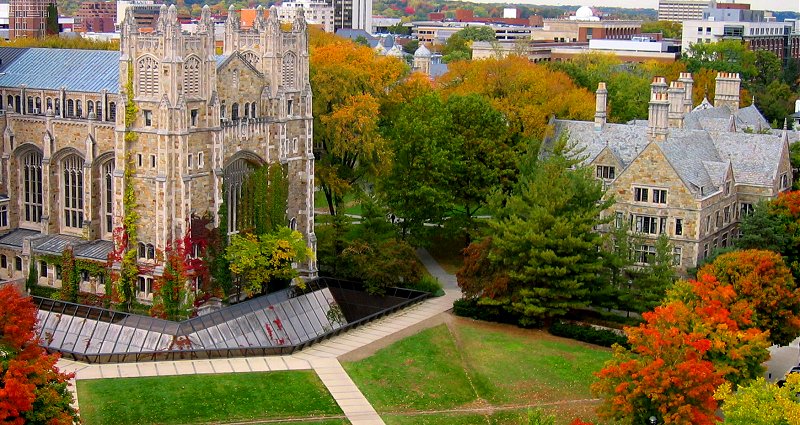
| Basically, "college" is a description of the University of Michigan... minus maybe the students discussing great philosophers. http://www-personal.umich.edu/~jensenl/visuals/album/2005/fall/ |
Enlightenment, in the eyes of Kant, is “man’s emergence from his self-imposed immaturity”, which he claims is “the inability to use one’s understanding without guidance from another”. This quote alone invalidates college as a source of “enlightenment”. First off, it can be argued that college is simply a way for professors to ‘spoon-feed’ students information so that they may “get... up the right educational ladders and down the right career chutes”. Let’s face it: the vast majority of students, if not all of them, view their college education not as a way to achieve a more enlightened frame of mind, but as simple springboard to a (hopefully lucrative) future career. How can students ever become enlightened by simply breezing through classes, unconcerned with actually learning and only caring about potential payoffs?
To put it simply, you ‘Kant’. The philosopher states that “laziness and cowardice are the reasons why so great a proportion of men...gladly remain in lifelong immaturity”. College can not serve as a means of achieving enlightenment if students are not motivated to break from the ease of life they so enjoy. It’s sad, actually; students have “book(s) to serve as [their] understanding”, and question neither these books nor their professors. Hey, as long as I get an A, why shouldn’t I take my professor’s words as truth? Today, going to college is not about receiving a well-rounded education or achieving a higher understanding, but majoring in the easiest or most profitable subjects. One recent CBS news article even explores the best major for “slackers...who don’t want to work all that hard to get a diploma. With that reasoning, it’s easy to see why a college diploma ≠ an enlightened manner of thinking.
How can this problem be fixed? All college students, including myself, must realize our capacity “[cultivate] our own minds”, as well as relinquish our ingrained prejudices. Luckily, college provides a great environment for us to do both of these things. By attending classes with a desire to learn and a disposition to question, much like that of Socrates, it is possible for students to finally reach an illuminated manner of thought. Go to lecture, soak up the information - but don’t always take an instructor’s word as law. Question, question, question in the search for truth - for, as Kant writes, a lack of ability to publicly question “would deny, render fruitless, and make detrimental to succeeding generations an era in man’s progress toward improvement”. Then, by integrating ourselves into the diverse environment that is college, we can renounce our prejudices, which only “serve as a leash for the great unthinking mass”. The University of Michigan is an exceptional place to become enlightened - here, we can learn to think for ourselves amongst brilliant minds, as well as live amidst an extremely diverse student body, each person possessing their own unique background and life experiences.
From this, it can be deduced that though college is a quintessential incubator for enlightened thinking, students are simply not utilizing it. Until we begin to think, question, and abandon our prejudices, we will never be liberated from “immaturity”. Most importantly, though, we must forgo our current lazy mentality. The “lack of resolve” of students to exercise our “own understanding” is the principal factor holding us back from enlightenment - if all we care about is getting an easy degree, we'll never escape the dark.
 |
| You have a degree from Stanford? Might as well mean nothing when it comes to enlightened thinking.http://dranonyme.com/stanford_and_yale |
How can this problem be fixed? All college students, including myself, must realize our capacity “[cultivate] our own minds”, as well as relinquish our ingrained prejudices. Luckily, college provides a great environment for us to do both of these things. By attending classes with a desire to learn and a disposition to question, much like that of Socrates, it is possible for students to finally reach an illuminated manner of thought. Go to lecture, soak up the information - but don’t always take an instructor’s word as law. Question, question, question in the search for truth - for, as Kant writes, a lack of ability to publicly question “would deny, render fruitless, and make detrimental to succeeding generations an era in man’s progress toward improvement”. Then, by integrating ourselves into the diverse environment that is college, we can renounce our prejudices, which only “serve as a leash for the great unthinking mass”. The University of Michigan is an exceptional place to become enlightened - here, we can learn to think for ourselves amongst brilliant minds, as well as live amidst an extremely diverse student body, each person possessing their own unique background and life experiences.
 |
| Socrates - this man knows enlightenment! http://www.livius.org/so-st/socrates/socrates.html |
From this, it can be deduced that though college is a quintessential incubator for enlightened thinking, students are simply not utilizing it. Until we begin to think, question, and abandon our prejudices, we will never be liberated from “immaturity”. Most importantly, though, we must forgo our current lazy mentality. The “lack of resolve” of students to exercise our “own understanding” is the principal factor holding us back from enlightenment - if all we care about is getting an easy degree, we'll never escape the dark.

I found your blog to be interesting in that you indeed support your argument of college today not being utilized as a source of enlightenment. I really enjoyed your discussion of Kent’s piece, and how you tied it into today’s world. However, I disagree. I believe that yes, in our world today people indeed go to college to “get the grade” but doesn’t this then allow us to become enlightened? It is necessary for college students to get an, "A” so they can search for the truth, and become enlightened in the work world. In essence, we all go to school in order to gain an education so we can succeed in the real world. The labor market is where we must become enlightened. In the real world, we can “question” and we can work, “toward improvement” in an environment that is more accepting of our quest. The fact that in the work world we are not being graded, but instead, exploring our options, and discovering our true calling, allows us to become truly enlightened in Kent’s sense of the word. I do not believe that we are being, “lazy” due to our lack of enlightenment through our higher education, rather we are being extremely diligent, and working extremely hard, to open opportunities for ourselves in the future. I would argue that college, though not a vehicle of enlightenment, it is an important step that allows one to become enlightened later in life.
ReplyDeleteThanks for the critique - you have a really interesting viewpoint regarding college as a precursor to the working world, the true vehicle of enlightenment. However, I’d have to disagree with what you’ve said, and here’s why.
DeleteI believe enlightenment is more of a ‘state of mind’ than a level that one can reach through “get(ting) the grade” or experiencing life in the working world”. You state that the working world is a prime place to “‘question’ and work ‘toward improvement’ in an environment that is... accepting of our quest”. However, I think it’s an even worse place to achieve enlightenment than college! The working world is called ‘the rat race’ for a reason - a lot of the time, people are working long hours in stressful jobs simply for the paycheck. They ‘live for the weekend’ - how is this environment conducive to enlightenment? Most of the time, people simply don’t care as long as they receive their weekly or bi-monthly paycheck; why would they bother questioning the system? Furthermore, people do work toward “improvement” in the working world - but this is only to increase salary and opportunities, not to achieve any sort of intellectual enlightenment.
College, like I said, is still the best place to achieve to enlightenment - this can’t, however, be achieved with the current mentality of simply striving for an A. We must be here to simply learn; hopefully, by adopting this mind set, we can create a more enlightenment populous for the future.
Thanks again for the comment.
Lindsey-
ReplyDeleteHalf way through your post I had to stop for a second to stop the flashbacks going home for Thanksgiving break. Throughout Thanksgiving day, I was getting overwhelmed with questions about my first semester of college, most frequently being asked “What’s your major?” Sure, I had been learning an absolute ton in all my classes and learning to live on my own without my mom bandaging every “boo-boo” was invaluable. However, despite all the newfound learning, I had no idea what I wanted to major in. When you quoted Kant saying that enlightenment, a form of college, should produce the “ability to use one’s understanding without guidance from another”., it made me think: Why do we have majors? I think we all agree that true enlightenment is valuable when we are truly able to think for ourselves about what to make of life, while majors funnel us into professions that might not exactly fit the professional mold that we desire in a career. Personally, I feel as though I have been funneled into the world of business world in which money rules all, totally contradictory to my beliefs and value of what is truly important in life. If we placed less value in the timeliness of determining a major and more time becoming truly enlightened in order to become more independent of the choices of others, we might become more in touch with our true vocation. I feel like “What have you learned about yourself?” might be an easier question to answer than “What’s your major?” next Thanksgiving from Uncle Bob.
Thanks for the read!
-Brennan