I would like to start off by saying that
I am not the Dalai Lama (as if you didn’t already know that – I guess this
would be a weird point in the year to find out a famous Buddhist monk was in
your Polsci 101 class). What I mean to say is that I am no expert on Buddhism.
I’m quite the newbie when it comes to the topic – I just took a class this
semester called Relig/Phil/Asian 230: Intro to Buddhism with Donald Lopez
(incredible professor). In fact, I would go through phases in which I
absolutely hated the material. BUT, I slowly learned to love the stories and
enjoy Buddhism, and this is the story of how.
 |
| Death. [source] |
It’s the
first day of my freshman year. I brave the bus down from North and find myself
obnoxiously early (by about 40 minutes) for my class, Intro to Buddhism. During
this time, I find myself wondering what to expect from my professor. Will he be
uptight? Foreign? Artsy? Mean? Overall crazy? I’ve heard so many scary things
about Michigan and how challenging it is – I practically expect someone who doesn’t speak English or give anything above a C-. I get more anxious as the
caffeine from my Panera coffee sinks in, finally walking into the MLB to face
my first lecture hall.
Of course,
I’m one of the first ones there. Luckily, I find my good friend Sam and relax.
Just as everyone is getting settled in, a skinny man walks in wearing a suit.
He gets up in front of the class, puts his hands together in a prayer position,
and welcomes us to Buddhism. Sam and I joke about how he sort of resembles Big Bird. Dr. Lopez soon tells us that enrollment triples when he teaches the class
because he is an easy grader. I feel much better.
 |
| In retrospect, he looks nothing like Big Bird. My apologies, Dr. Lopez. [source] |
Anyways,
Dr. Lopez (I’ve always wanted to call him D-Lo but I think it’s a better idea
to restrain myself on that one) teaches the class like its story time. He uses
absolutely no technology, except for an overhead on which he writes
hard-to-spell words. He gives us basic concepts of Buddhism, and then explains
them using parables from famous Buddhist texts. We have two midterms, and one
essay. That’s it.
These
parables are often ridiculous. For example, here are the edited notes I took on
one in class. The essence of the parable is caught in the final lines:
Naropa does all of this, terrible physical torture without
being taught anything. Tilopa eventually takes off his shoe (worst in India -
pointing dirtiest part of body at someone is like giving the finger) and smacks
Naropa in the face….and Naropa is enlightened.
One shoe to the face gives you wisdom? SURE, Dr. Lopez, SURE. Let me just go slap myself around with some Nikes and I'll let you know how that works out. I found myself constantly asking my GSI, Martino, "Do they actually believe this stuff happened?" He would push back, giving me the same answer every time: "Does it matter?" This would frustrate me, being as Type A as I am. OF COURSE it matters! How could you base your entire life off of something that didn't happen? This was my daily struggle with Buddhism.
 |
| A Mahayana statue of a Buddha [source] |
"Three cut reeds can stand only by leaning on one another. If you take one away, the other two will fall."
To explain how these three concepts relate to each other, Dr. Lopez held up a dollar bill in lecture. He said, "What makes this a dollar bill? The ink? The paper? The writing?" He explained that essentially, the dollar bill is only considered such because of the value we place on it. It has no essential identity; no one that didn't know what it was would know that it was a dollar - as is true of all things. Martino took this further in discussion when he held up a keyboard and asked similar questions. Identity exists because we place it there.
Less than a week later, I saw Professor LaVaque-Manty show nearly the same dollar bill example in lecture. This time, it was being used to explain Plato's Allegory of the Cave.
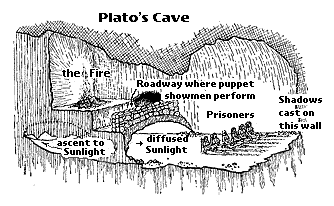
In the Allegory of the Cave, people are chained to a wall from the time the are wee tots, the only images they see being shadow's from people and objects on the walkway behind them. They see the shadow of an ox, and they call it an ox (or a gurflaglefish, or really anything, but its consistent each time they see the object). They think that the shadows they see are more than shadows - they are the objects themselves. They live in a world of shadows, but are completely unaware.
 |
| Kinda muggy in there. [source] |
He gave nearly the same argument, comparing the gurflaglefish to the dollar bill. The identity of the gurflaglefish came solely from the prisoners' perception. The identity of the dollar bill came solely from the our perception. You look at a dollar bill and think, "That's a dollar bill," but what truly is the essence of a dollar bill? It is simply ink on paper, yet we give it an identity, a value, and believe it to have an inherent existence as a bill.
 |
| Actual photograph of me in Polsci 101 a couple weeks ago. [source] |
Both the Buddha and Plato explained the idea that we ascribe identities to things but don't understand the true essence of them (they probably thought they were sooo original, too). The only difference is that Plato thought that things actually HAD a real identity - that there is really a "truth" - while the Buddha claimed that they did not. If your mind isn't blown as well, you're not paying attention.
I thought back to the course title. I had taken Intro the Buddhism as Relig 230, but I remembered that it was also called Phil 230. Buddhism isn't just a religion - it can also be taken as a philosophy. The Buddha was just as much of a philosopher as Plato was, but he doesn't get as much credit for it. The Cave demonstrates popular Buddhist beliefs, and I'm almost positive Plato wasn't a follower. After this realization, I began to see Buddhism much differently.
Here are my final thoughts: Just because Buddhism uses ridiculous parables that probably didn't happen, it doesn't mean that there is not something to learn from then. After I came to this conclusion, going to Buddhism became enjoyable. I loved hearing the stories and felt that, though I am not Buddhist, I had something to gain from listening to them. I'm even taking Tibetan Buddhism with Donald Lopez next semester and am considering applying to go on a trip to India for two weeks with some people from the class. Plato didn't just open my eyes to truths about existence - he helped me understand religion as well.


I find your proposal interesting that Buddhism is a philosophy as much as it is a religion. It tackles many aspects of our lives and attempts to impose moral absolutes upon our decisions and a reward system for good actions. In that sense, do you believe that such an association can be made for any religion, then? Each has its rights and wrongs, and gives us reasons to follow that dogma. That said, those with “dust in their eyes” may include people who cling deeply to such religions and refuse to see the world from other points of view. I wonder if such Buddhist scholars have ever wondered if their eyes are ‘dusty’ via their own beliefs, and have the same difficulty viewing other philosophies in an open-minded light.
ReplyDelete