The issue then becomes motivating a certain demographic to vote. While African Americans did have a higher turnout than before in the 1930s -- when FDR was running for president -- they still did not have much of an effect proportional to how many possible voters there were. In order to secure victory, then, presidential candidates would go to areas, such as Harlem, to promise them things. Things that they would not do.
Malcolm X covers and is aware of this in his speech. And he is tired of their oppression and hypocrisy -- they meaning the white oppressors. Keep in mind that in the 1960s, MLK Jr. and many other activists were enforcing sit-in movements and crossing into "Whites Only" areas. As a result, blacks were being punished for their supposed insolence.
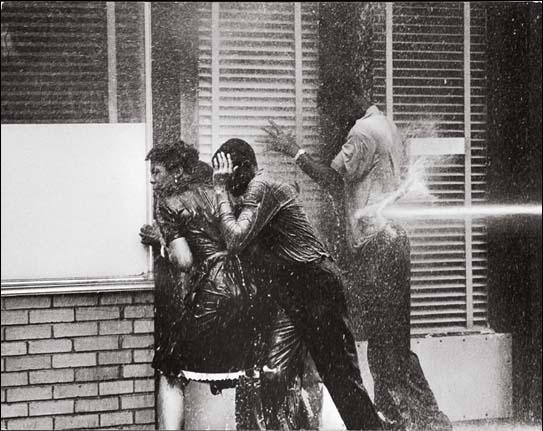
So this explains why Malcolm X is giving his speech. While Martin Luther King, Jr., enforces his pacifist attitude, Malcolm X believes this is not enough. Yes, they are given the opportunity to vote, but it should not end there. What should be done is if he along with other blacks are marginalized, they will have to take up violence.
While that was a nice summary, what this post aims to explore is how this has affected subsequent history. Directly, there were the Black Panthers and gang violence eventually erupted. The focus here is not on that, despite how interesting the rise of gang violence is. These are side notes. The focus, rather, is on how different minorities progressed and how racism has evolved.
 While Malcolm X became more passive towards the end of his career, his call for arms was a new idea. There was no real parity between the whites and the blacks prior and there was no possible method. Violence was not an options, especially when blacks did not have much access to arms and historically, slave revolts yielded little success. But there is more than just violence to Malcolm X's proposal. There is this idea that while they will follow the rules of the system, that they will do something in an attempt to make their voices heard, should that fail, there is something else. That way the violence is not unwarranted. Rather, the violence is a justification of their rights, a message that they were wronged by following the rules of the their system. Violence was then the only way to fight the system.
Even if these people were not violent, there was a feeling of aggression instilled. With the collective efforts of both MLK, Jr., and Malcolm, blacks had pride in their race, something that has never really happened even with Marcus Garvey in the 1920s and his "Back to Africa Movement." The only people who had pride were educated scholars, as shown by the Harlem Renaissance. But now, every person was feeling a part of this collective identity.

Though this seems fast, this idea of racial identity began to spread to not only black but also Hispanics and Asians. Since they, too, were marginalized groups, they felt the need to find security in numbers so that they may also hope to be treated the same way as whites.
This then leads a bit to contemporary racial issues. Since many blacks were already congregated by area, there was no real move to the suburbs for them. Even if legislation said whites were not allowed to discriminate based on color, many still did. When the Highway Act made possible a move to the suburbs, many blacks tried to escape the inner city conditions. Unfortunately, this was not possible since house sellers did not allowed blacks to buy their homes, trapping them in an area. This has then led to an exclusivity among blacks.
Which brings me to where I wanted to be. In the movie Do the Right Thing, by Spike Lee, Spike Lee explores the double-sided racism. In an area of Brooklyn mainly dominated by blacks, there are struggles in both identity and assertiveness. And, of course, it all boils down to the racism of it all. Blacks feel as if the whites are imposing, and the whites feel that the blacks are uncivilized. The video below sums up the racial attitudes of the movie. If you have not seen it, it is really worth watching.
While blacks are still legally equal, there is a de facto stripping of rights. Even now, though racism is instilled in children as politically incorrect, there is still a subtle discrimination. Since Malcolm, a lot has been accomplished in terms of providing rights for blacks. We even have a half black President. But society has become more tolerant of other races other than accepting. Rather than have us all seen as a collective American identity, we are still distinguishing people based on the color of their skin. Despite Carter claiming that America is a "beautiful mosaic," I would much rather be a part of a "melting pot."

Allen, great post.
ReplyDeleteI do agree that I would rather see America as a melting pot than a beautiful mosaic. While the rate will likely never be 100 percent, for the most part people today are accepting of another's race or religion. The problem is that many are only accepting of race or religion though. Many people don't embrace other peoples race or religion, which is fine, but America would be more like a "melting pot" if this were the case. For example, instead of someone accepting another as a Muslim, our country would be better off if that same person embraced this persons religion, and made an effort to meet and get to know that person. While we may accept our differences, there is still sometimes an awkward distance between people of different ethnic/racial backgrounds. Many people just don't make an effort to try and diversify themselves and they just stick close to the people most similar to them, instead of branching out and meeting other people.