 |
| What makes a student succeed in college? |
With all this talk of college, one might be reminded of the article we read at the beginning of the year, “Live and Learn” by Louis Menand, which discussed exactly this idea of why we have college. My teacher’s view on college seems to correspond most closely with Menand’s first theory of college - that it provides a reliable predictor of productive potential in the form of a GPA. In other words, a high GPA indicates to employers those students that are going to be most useful. My question to explore now is the following: what kind of traits make a college student able to find success - and do these traits truly correspond to success beyond college?
This is exactly the question that Menand poses in his article when he asks if the bachelor’s degree is “still a reliable marker of productive potential”. With regard to the question of how one finds success, there are very interesting arguments outlined on the topic in the book “Outliers - The Story of Success” by Malcolm Gladwell. While Menand argues that IQ, more or less, translates into who is going to be the most successful in college and in life (he calls college an extended IQ test), Gladwell argues that once you’ve hit a certain benchmark of smartness (an IQ of about 120), any further increase in intelligence doesn’t necessarily help your chances of success.
 |
| Chris Langan |
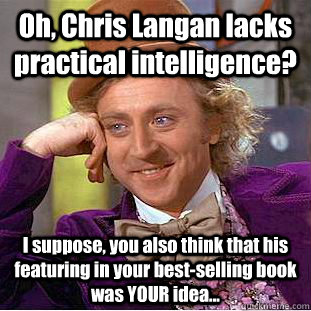 |
| Well, even though Chris Langan didn't do so hot in college, we can at least give him credit for getting all this media attention! |
On the same topic Gladwell also cites an intelligence study performed by Lewis Terman which tested for students with IQs above 140 and followed them throughout their lives. Many would expect these “termites”, as they were named, to grow up to be Nobel prize winners, however we saw that only a fraction of them found success - the rest were in dead-end jobs or unemployed. In fact, two Nobel laureates - William Shockley and Luis Alvarez - were tested for the study and subsequently rejected because their IQ scores were too low. What this illustrates is that, as Gladwell describes it, once your IQ is high enough, around 120 or so, any further increase in intelligence does not necessarily translate into more success. What does translate into success is hard work. Gladwell shows that successful people like music prodigies, the top chess players, Bill Gates and The Beatles all have one thing in common: they have accumulated at least 10,000 hours of practice in their field - a length of time Gladwell argues is how long it takes for anyone to truly master a subject. We would certainly expect, for example, that the two Nobel laureates that were rejected from the study simply worked harder than the “gifted” members of the study - enabling them to find success even though they were less intelligent.
Therefore, we can see that those who truly have “practical intelligence” and those who also work extremely hard, given that they are smart enough to handle college material, are going to be the most successful in college. When employers look at college graduates - potential employees - they hold interviews to try and gauge, in my opinion, that practical intelligence. Once these graduates are hired the employers have evaluations to grade the workers on their work ethic, which Gladwell asserts is so important. So we can see that these traits certainly are very valuable in the workforce. I do agree with Menand - I think a college degree is a great indicator of productivity, but when it comes to why someone succeeds in college, I’m inclined to agree with Gladwell. College, therefore, is ultimately a great opportunity to prove that you have a good work ethic, social savvy, and that you’re smart enough to be the flexible, adaptive, and productive worker my calculus teacher described.
images:
http://www.friendsofquinn.com/uploads/images/blog/Success_Sign.jpg
http://onemansblog.com/wp-content/uploads/2007/11/chris-langan.jpg
http://i.qkme.me/3og5h5.jpg

I always find it very interesting to get a teacher's perspective on the "value" of education. You would think that teachers/professors would almost always say that education is ONLY (or mostly) about the experience and exposure; sometimes, such as your calculus teacher, you hear something a little different.
ReplyDeleteI think that it's also very hard to determine the difference between the "college experience" and the "usefulness of college." Obviously, if one only attends college for the GPA and such, they will simply fall under your argument that a certain IQ and beyond isn't going to contribute to their successful. It becomes a "Congrats, you're book smart and you can't do anything else. Good luck in the REAL WORLD." Which, for those who are only very "book smart," this is a very unfortunate situation. But I like that you argued that the SUCCESS also comes from the hard work that is put in. I think that determination, hard work, and PASSION are such vital components for success. Yes, if you're smart that's great! However, there is something more needed to ensure success in life. And you did a very well job of alluding to that.
Stanley,
ReplyDeleteI was reading an article on the merit of even obtaining a college degree and this post related very well to the New York Times article.
I'm a bit surprised that your teacher wasn't offended at all by the question regarding whether Calculus was useful or not. I remember last year, a student asking the exact same thing of my biology teacher during the unit on Plants and her not being at all impressed by his question! I think your teacher's opinion is quite interesting, because very few teachers would in fact express their true opinion on the matter.
In response to your question about what really allows a student to succeed, I think that all matters on what success is measured by. If success is measured by financial wealth or awarded academic achievement then I agree with the idea that college teaches very few skills that are necessary for a specific job, unless it's a profession related to medicine or law. Success is in large part luck as well as, as you stated, hard work. I agree with your teacher on the idea that most of the actual training for a job doesn’t occur in college but on the job. I have a friend who graduated from an ivy league university and currently works in the city as a consultant. She always says that most of what she does everyday she learned in a span of weeks not in the 4 years at her college where she competed for a good GPA with the cream of the crop. But her GPA was allowed her to even be considered for the job, and thus it justified her time at college and her degree.
I like how you incorporated Gladwell’s book with Menand’s article. I feel as if although the purposes are divergent they both still express very interesting points on the purpose of education and success.
Malini
Stanley,
ReplyDeleteI thought this post was very inspired and incorporated a book that I really enjoy, Outliers (though I’ve only read parts), because this is a great comparison to make to Menand’s article, which is so relevant to us, especially at the end of the semester with all of our workloads peaking and the horizon of next semester in sight. On the subject of what your teacher said about learning concepts in school having the main purpose of mental flexibility and skill-learning abilities, I definitely see how you interpreted that as the meritocratic theory of education and it makes sense, but I would argue that you can also view it as the second theory of education, because the classes are not necessarily just to sort out people who do not have the skills to excel in them, but to widen your scope of reasoning capabilities, thus making you a more well-rounded individual who can approach issues and assignments from more than one perspective. Your examples from Gladwell are fascinating ones, and you would probably be interested to learn about emotional intelligence if you have not already, because this is gaining increasing attention in regards to its role in success.
Great post!
Daisy
Stanley-
ReplyDeleteI really like what your post was able to convey. I, for one, feel that the idea of college is more of a test of a person's ability to adapt to situations and learn how to accomplish a task rather than actually learning the information at hand. Sure, you need to know the information in order to accomplish the task, but then we must ask the question of how many tests that you've studied for do you actually remember all of the information which you studied? We remember things which are important to our development as a thinker, and those things help us in the future. When we learn things, we shape the way our mind will interpret similar subjects in the future and in turn are able to be successful in other fields.
I also think that the concept of mastering a subject, as you stated in the paper, is more important than people give it credit for. Some of the most successful people in certain fields, such as entruprenuers, don’t have the highest IQ's or the best college education. However, they know what produces success and are able to concentrate their efforts in places that will directly translate to that.
Overall, you brought light to another very good point in relation to the Menand article we read. Frankly, I think the book you reference should have been talked about in the conversation we had in the beginning of the year.
Stanley,
ReplyDeleteI really enjoyed reading this post! The topic of practical intelligence that was bought up was very interesting. I think that practical intelligence plays such a big role in success. As you stated in the post, after you hit a certain number in IQ intelligence, it's not much help to the person. When going to a job interview, the interviewer doesn't know the persons IQ score. This is where practical intelligence comes in. Knowing how to appeal to people is key. Knowing what to say and saying the right things is what people look for. Regardless of how intelligent a person is, it is vital for a person to know how to get there way by appealing with words and presentation. I do agree with you when you says that college indicator is a great indicator of intelligence but how you present your college degree is key.
Very interesting read!
ReplyDeleteI was shocked that your calculus teacher, one who must be in love with the academic realm and the pursuit of knowledge, did not advocate Menand's other theory of education, that of creating informed citizens and supporting the acquisition of knowledge!
I enjoyed your connection between Gladwell and Menand, particularly the analysis of Gladwell's thoughts concerning the lesser qualities that accompany extreme IQs, those that are too high or too low. Your insight regarding practical intelligence made me wonder if a person of low IQ (lower that 120) possessed large amounts of practical intelligence could dominate a meritocratic system or even win a Nobel Prize. This question is certainly stimulating and will have me puzzled for days. I would love any additional input!
Ben