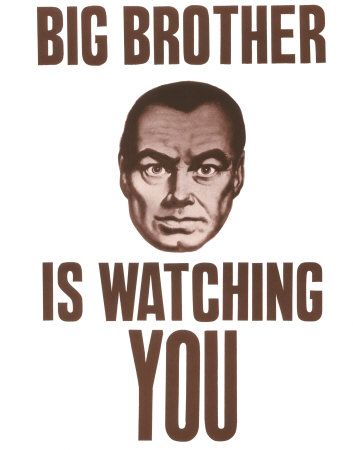
In lecture, we were introduced to Plato's Allegory of The Cave. The theory in itself is a tad complex, allowing for individuals to form various opinions and perceptions of what exactly the cave and cavemen represent. When learning about the allegory, I found myself constantly thinking of the novel 1984, written by George Orwell, which I read my senior year of high-school. Both the theory and the novel have synonymous themes of a certain type of "common sense" that is formed by society. This common sense blinds people to what is real, and causes them to believe only what they see (for instance, the shadows in the cave.)
The book introduces us to Winston, a worker for the ruling party in Oceania (literally referred to as "The Party). Throughout the day, Winston is monitored and controlled by the Party, which put restrictions on free thought, sex, and anything they interpret as individuality. To enforce these standards, the Party uses objects called telescreens, which not only monitor but also relay information to the masses. Essentially, the Party is able to tell the community what they want, a form of selective information. By thinking about Plato's allegory, we can understand that the Party is using "shadows" in order to keep the society brainwashed. Winston begins to understand that the Party is relaying nothing but fallacies, and illegally purchases a diary to record his individualistic thoughts.
Winston wants to leave the cave that is Oceania. He has freed himself from the bonds that continue to hold down everyone else in the cave, and attempts to escape. He is not forced from the cave as Plato's allegory suggests, but Winston is able to see the "Forms." He meets a woman, Julia, who understands him and also opposes the Party, and the two constantly try to hide from the danger they would experience if caught.
He unfortunately meets his demise when mistaking someone for another opposing member of the Party, only to be trapped. Winston's end only results in him returning to the cave and the shackled being strapped back on for good. It is clear at the end of the novel that he has come to accept the "common sense" that the Party creates.
In a sense, I think that George Orwell gave us a slight glimpse into the future by writing 1984. The book has various parallels with Plato's theory, and even in current society, our media is controlled by outside sources who pick and choose what they want us to see. We haven't reached a point of completely exiling individuality in our society, but I could definitely see it as a possibility should the government ever consider it effective.
Sources -

1984 is one of my favorite novels and it was quite interesting to read about the parallels between Orwell and Plato. I think there are a lot of books and movies that depict a protagonist realizing that he lives in the cave and his journey outside of the cave in hopes that he can save himself and the rest of humanity. However, what's interesting about 1984 is that Winston fails to even exit the cave fully himself. He has had a glimpse of what life outside the cave could mean with his relationship with Julia and the various words that he writes.. but never does he truly experience life outside of the cave. I wonder what Orwell could have been saying through Winston's failures and if he had ever read Plato's allegory. 1984 itself was meant to be a satire against about a totalitarian state so I would not be surprised if Orwell has delved into some Plato as we have.
ReplyDeleteCool post Dallas. Having read 1984 and watching the movie in high school I find this comparison interesting yet controversial. I believe the cave does a better job controlling the people inside. Where the party in 1984 attempts to keep everyone in the cave, Palto's cave hand selected the person that was to see the real world. Winston and Julia know what they have been prohibited from doing while the people in the cave have absolutely no idea. Yet, overall a strong comparison that I find quite interesting.
ReplyDelete