Now in this day and age, the benefits of working in teams - whether its to develop a laptop or simply to understand some homework - is not news to anyone. In fact, it seems that, in general, when human beings work together everything is much easier and nicer. Just stop and think for a second - when was the last time you actually accomplished anything without the help of someone else? This question is not meant to be sarcastic (I'm not saying that you're not an independent and successful college student, we know you are!), it is meant, rather, to address the fact that in today's society everyone takes advantage of the facilitated exchange of goods and services. For example, you're a starving college student, right? Feeling a bit hungry? What are you going to do? Well, you have a couple of options, including the option of making the food yourself! So, if you were to do that, you'd probably go to the store and buy some of the ingredients necessary for your meal, right? But wait... if you were to do that would you really be making the food all by yourself? For instance, if you brought some bread to make a sandwich, you would realize that the bread you bought is not a product of your own efforts but that of someone else's. Somewhere along the line, a worker in some industrial bakery made that bread for you so that it would be readily available to you in the store whenever you needed it.

So what can we conclude? First off, there's probably nothing better than commercially produced sliced bread. And that's probably mostly because its so convenient. But more importantly, we can conclude that if we didn't have the exchange of goods and services everything in life would be a lot less convenient. You wouldn't be able to just whip out some cash that you earned working at your job in exchange for some of that tasty bread (I'm sorry if I'm making you hungry). You probably see where I'm heading with this by now. We have things so easy because we have a working economic system that allows these exchanges because everyone is willing to work together. And the only way to accomplish this very efficient level of cooperation is through the establishment of something that facilitates it - ultimately, the establishment of a government. That's definitely something that we all take for granted, and sometimes we should take a second to realize that not everybody has it that great. What if, for example, we didn't have a working government? What if no one was willing to work together, what would things be like then?
In order to answer this question I'll start off by looking at our less evolved friends, animals and plants! They obviously don't have any working governments established - I mean there might be things such as wolf packs which exemplify small little groups of animals working together, but of course nothing as high-level or
complex as the governments and economic systems that humans have established. Furthermore, if you look in nature there are relatively few examples of mutualism between two species. In other words, there aren't many species that work together for the benefit of both in the way that humans do. Animals often fight over things that they want. There's no trading or diplomacy as there is with humans. All animals care about is something called self-preservation - they care about staying alive. All their reactions to their surrounding are an attempt to preserve their existence. This is, in fact, one of the characteristics of living beings - they react to stimuli. For example, when you laugh at a joke you are reacting to the stimuli of the joke that is its absurdity. When animals feel threatened they react with the fight-or-flight response in order to self-preserve. All of these ideas are very comparable to something called the state of nature, a place without a government in which it is essentially every man, animal, or plant for itself.
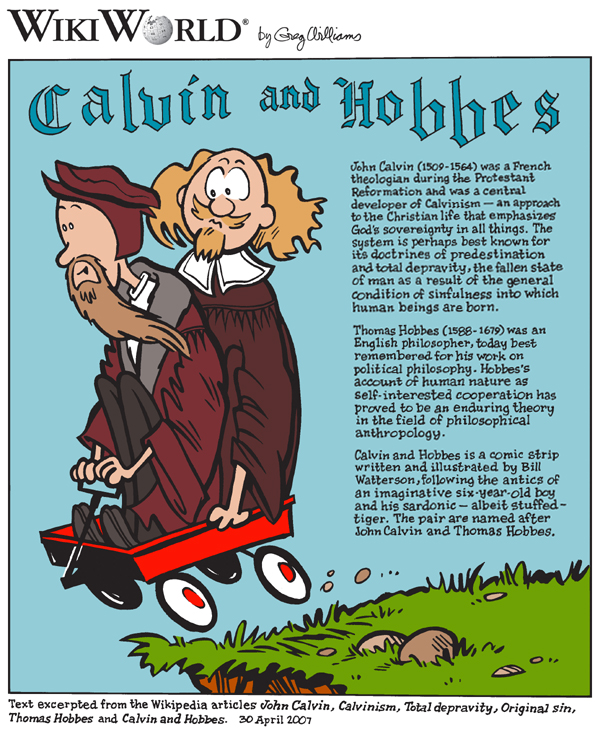 |
| Calvin and Hobbes in the comic strip "Calvin and Hobbes", by Bill Watterson, were actually named after theologian John Calvin and philosopher Thomas Hobbes. |

I think this post is very engaging! You explained the state of nature and the state of government in interesting, detailed ways. Many times, it seems people forget how lucky they are to live in a safe, democratic society. Just the fact that we, the people, get to decide who governs us is something that we shouldn’t take for granted. People may complain that our form of government is inefficient and not representative of the people, but I think the U.S. does a pretty good job considering our country’s diverse population and differing political views. There’s no doubt our country has problems that still need to be fixed, but as you said, we have it easy compared to countries such as Somalia and Sudan. Given the choice, I believe most, if not all, Americans would chose to live under an imperfect state of government over the state of nature.
ReplyDeleteAs for efficiency, I think it’s safe to say America does a pretty good job. The society we live in is always trying to make things quick and easy. It put things in perspective to think it only takes us a minute to get something to eat or drink, whereas in some countries processed or already made food does not exist. As for working together, I agree that it can be more efficient. However, I think there are some things in life that you can’t learn in a group setting, or at least should be attempted alone first. For example, I think the readings from this class should be done individually so that one has to interpret the greater meaning before it is presented in a group setting. If everything was done as groups, there would always be people who would end up not learning much at all.